Feature
Geotechnical
Borings, soil profiles, slope stability, settlement.
Use this add-on:
Overview
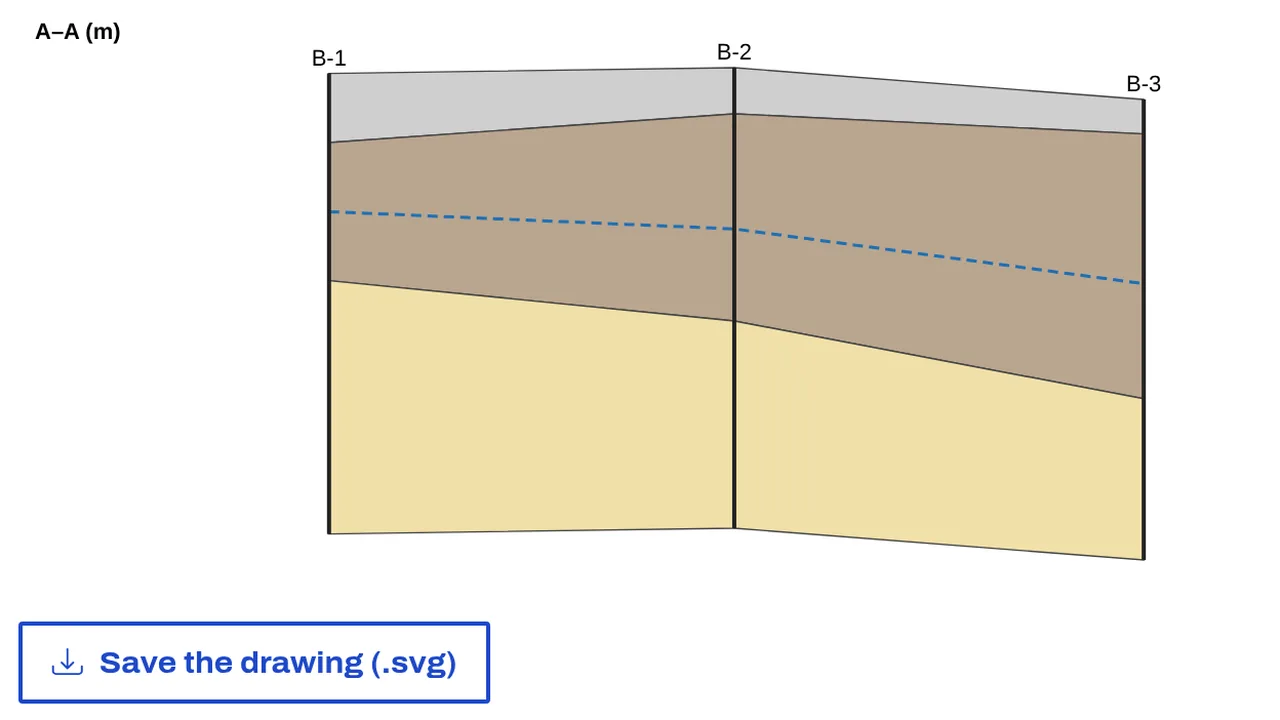
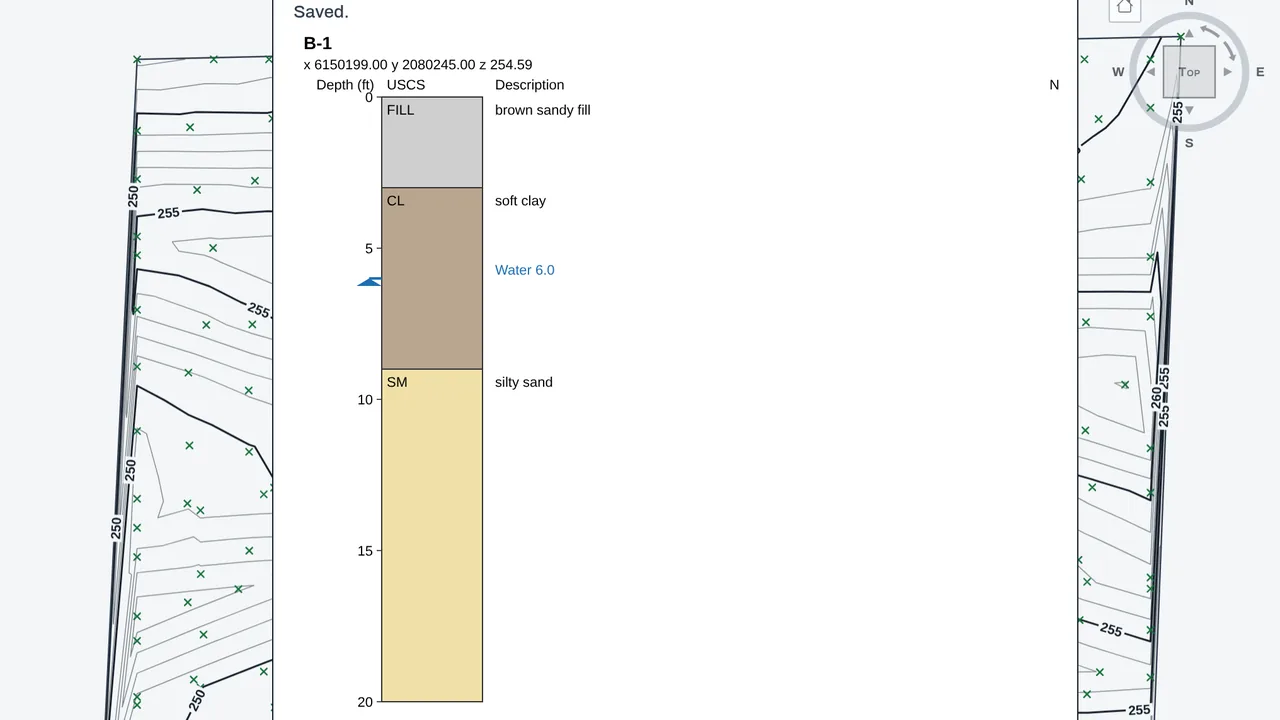
Geotechnical tools in CivilCraft: boring logs with soil layers, a soil profile between borings along a section line, slope stability by Bishop's simplified method or the ordinary method of slices with a search for the critical circle, and settlement under a footing (immediate and consolidation, with time). It is a calculation aid for an engineer. The soil values are the engineer's, from the tests of the site.
Who it’s for
- Geotechnical engineers who log borings and want a soil profile along a section line.
- Civil engineers who check the factor of safety of a cut or fill slope against a target.
- Foundation engineers who estimate settlement under a footing from borings.
What you can do
- Open Soils and slopes from Surface › More › Soils and slopes.
- Add a boring with its position, depth, groundwater level and layers (from, to, USCS soil, unit, unit weight, cohesion, friction angle, compression and swelling indices, void ratio, consolidation coefficient and blow counts). The boring log is drawn for you.
- Add a section line and see the soil profile of the borings near it.
- Add a slope along a section, with its materials, surcharge, water and seismic coefficient, and choose Bishop or the ordinary method. The critical circle is found and the factor of safety is set against the 1.5 target.
- Add a settlement for a footing load (its pressure, size, depth, centre or corner) on a boring, and read the immediate and consolidation settlement, with time.
- Read Problems for a factor of safety under its target, a slip circle that does not fit the section, and a settlement over its limit.
Methods and standards
Method of slices: Fellenius (ordinary) and Bishop (simplified, solved by iteration) for circular slip surfaces, with a search for the critical circle. Taylor's stability numbers for toe circles in clay. Pore pressure from a water table or from the ru ratio. Consolidation settlement by the log formula with the compression or swelling index (Terzaghi); time rate by Terzaghi's Tv; secondary compression (Mesri); stress under a loaded rectangle by Newmark and Fadum, with the 2:1 rule as a quick check; elastic settlement of a flexible rectangle (Timoshenko and Goodier); SPT blow counts corrected to N60 and (N1)60 (Liao and Whitman; NCEER). Sources are cited in the file header.
Data and sources
There is no soil library. Soil values are yours, from the site tests. The soil table gives starting values for each code, and these are placeholders, not soil data. Water weighs 9.81 kN/m3. The maths runs in SI units; the screens convert from the project's units.
Verification
bin/test-civilcraft-geotech.mjs: 39 passed, 0 failed, against published worked values: Taylor's stability numbers (0.191 at 60 degrees, 0.219 at 75 and 0.261 at 90), an infinite slope, Newmark's influence value of 0.1752, Terzaghi's Tv of 0.197 at 50 % and 0.848 at 90 %, the elastic flexible square (0.561 at the corner and 1.122 at the centre), and a normally consolidated layer worked by hand. Recorded in docs/0.8-sessions/civil-geo_PART_2.md. Not yet checked against a reference case from a real site.
Limits
A calculation aid, not a stamped design: an engineer checks every result. Slope stability covers circular slip surfaces only. Settlement is a half-space estimate, and leaves out soil layers of limited depth, consolidation by water flow and ground-water changes. Slices with a base too steep for the Bishop method are flagged in Problems, and the result then needs care.
Files and formats
The data is kept in the CivilCraft project file under one key: borings, section lines, slopes and settlements. Drawings download as SVG, named after the file.
Get started
- In CivilCraft, open Surface › More › Soils and slopes.
- Add a boring with its position, depth and layers, then add a section line that passes near it.
- Add a slope or a settlement and read its factor of safety or settlement, and Problems.
Languages
No languages are listed for this add-on yet. Its maker may add some.
Works in
| Edition | Works | Note |
|---|---|---|
| Browser (/use) (yours) | Added on demand | Fetched the first time you use it, then kept for offline use. |
| Studio from getcadcraft.com | Added on demand | Fetched the first time you use it, then kept for offline use. |
| Microsoft Store | Added on demand | Fetched the first time you use it, then kept for offline use. |
| Google Play | Added on demand | Fetched the first time you use it, then kept for offline use. |
| iPad and iPhone (App Store) | Included; switch it on | Part of the reviewed app; your list switches it on. |
| Custom build | Added on demand | Fetched the first time you use it, then kept for offline use. |
Comes with
Nothing else.
Needed by: Civil and site engineering, Dam and hydropower engineering, Environmental engineering (air, soil remediation, permitting), Geological and petroleum reservoir engineering, Geotechnical engineering, Mining engineering, Structural engineering, Tunnel and underground engineering.
Versions
| Version | Channel | Date | What changed |
|---|---|---|---|
| 1.0.0 | stable | October 28, 2026 | First version in the Library. |
Licence and maker
CadCraft (CadCraft, first-party). Licence: Apache-2.0. Dependencies carry their own licences, listed on their pages.