Engine
Field kernel
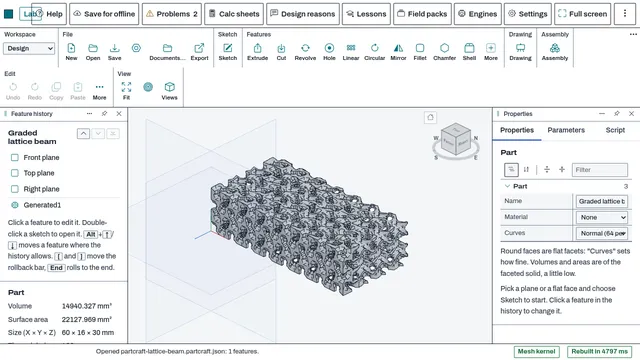
Implicit geometry: lattices, TPMS, rule-written parts.
Built on it
- Additive manufacturing engineering — Print-planning sheets for PartCraft and ModelCraft: layer count and print time, material and cost with infill, overhang check and plate packing.
- Aerospace (aircraft) — Aircraft teaching sheets for PartCraft: wing lift, stall and induced drag, weight and balance, and the published 4-digit airfoil thickness and camber formulas.
- Astronautics and space systems — Orbital teaching sheets for PartCraft: circular orbit speed and period, two-burn transfer delta-v with the rocket equation, and radiative equilibrium temperature.
- Biomechanical engineering (implants, prosthetics) — Implant sheets for PartCraft: stem bending stress, lattice stiffness by the Gibson-Ashby relation and joint force against body weight.
- Materials science and engineering — Materials sheets for PartCraft: stress and strain, an Ashby-style stiffness index, Goodman fatigue factor and composite modulus.
- Naval architecture and marine engineering — Ship sheets for PartCraft and ModelCraft: box-barge hydrostatics and metacentric height, righting lever and friction resistance.
- QuantScope — QuantScope: the engineering engine for CadCraft Studio. Write parts from physics: generators and data sheets.
- Tooling, mold and die design — Mold and die sheets for PartCraft: shrinkage and cavity size, clamp force, cooling time, draft offset, and punch force with strip utilisation.
Use it in your add-on
Name it in your manifest's needs. When someone adds your add-on, their account brings this engine too, and every edition loads it the first time your add-on needs it. Version ranges arrive with AL.13.
{
  "id": "com.example.my-addon",
  "apps": ["partcraft", "modelcraft"],
  "needs": ["engine.field"]
}
Methods and standards
Signed-distance fields: primitive distances, minimum and maximum for booleans, a polynomial smooth minimum for blends, offset, shell, rigid and uniform scale transforms, and the triply periodic minimal surfaces gyroid, Schwarz P and diamond. The field has no clock, random number or trigonometric call, so the same spec always gives the same result. Contouring turns the sampled field into a mesh.
Limits
The kernel makes geometry, not design decisions. The meshes are contoured approximations, not exact B-rep solids. Memory and time grow with the part's size and with finer voxels, so a very large or very fine part can exceed the voxel budget; the manufacturing check reports that. The 0.1 mm benchmark is still to be run.