Feature
Pool spec: Europe
The European spec for the Pool generator: concrete shell and pool water values from the Eurocodes and the EN pool standards, each with its standard, clause and how it was read.
Use this add-on:
Overview
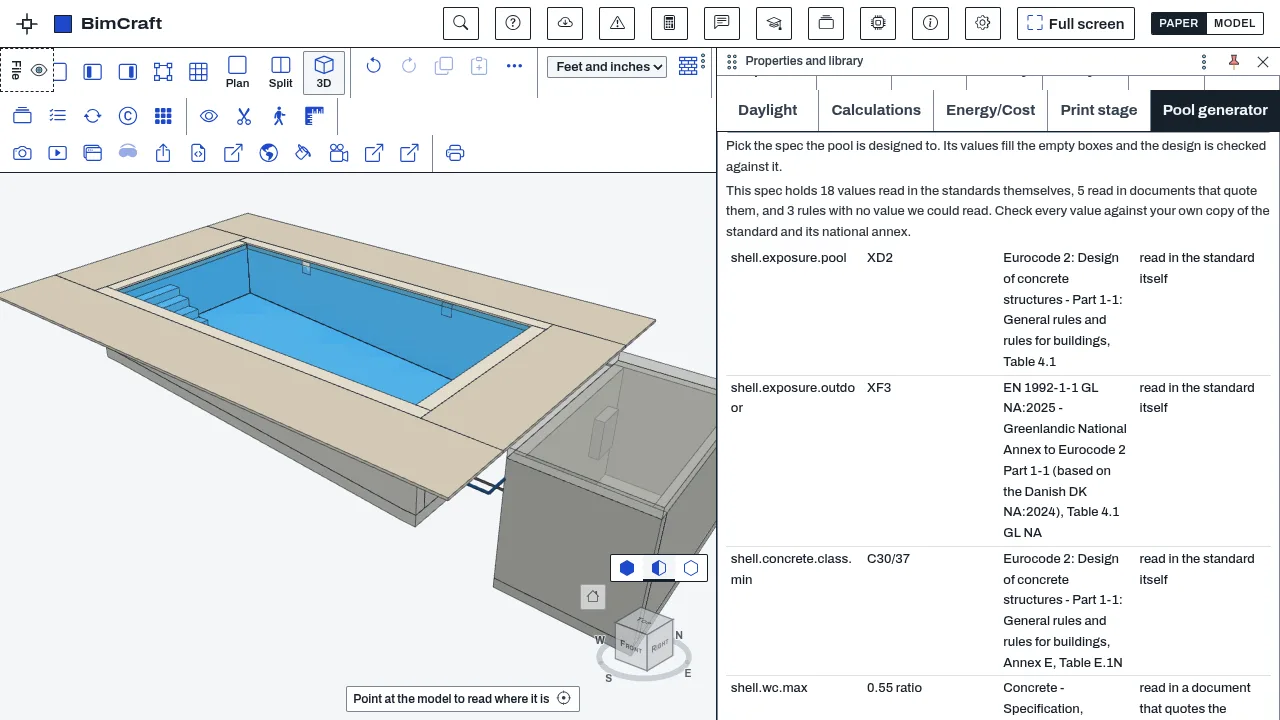
This is the European spec for the Pool generator: a data pack of the values that norms set for a concrete pool shell and its water circulation, taken from EN 1992-1-1 and EN 1992-3 (the concrete shell: exposure class, concrete class, cover, crack width, wall thickness, bar spacing), EN 206 (water to cement ratio), EN 16582 and EN 16713 (domestic pools: leak test, turnover, filter rate, suction outlets), EN 15288 (public pools), and national rules where there is no European one: the German accident insurers' slip classes, DIN 19643 for public pool flow, and French rules for barriers and skimmers. Switch it on and pick it in the Pool generator's Spec section: its values fill the boxes you left empty, and the design is checked against them.
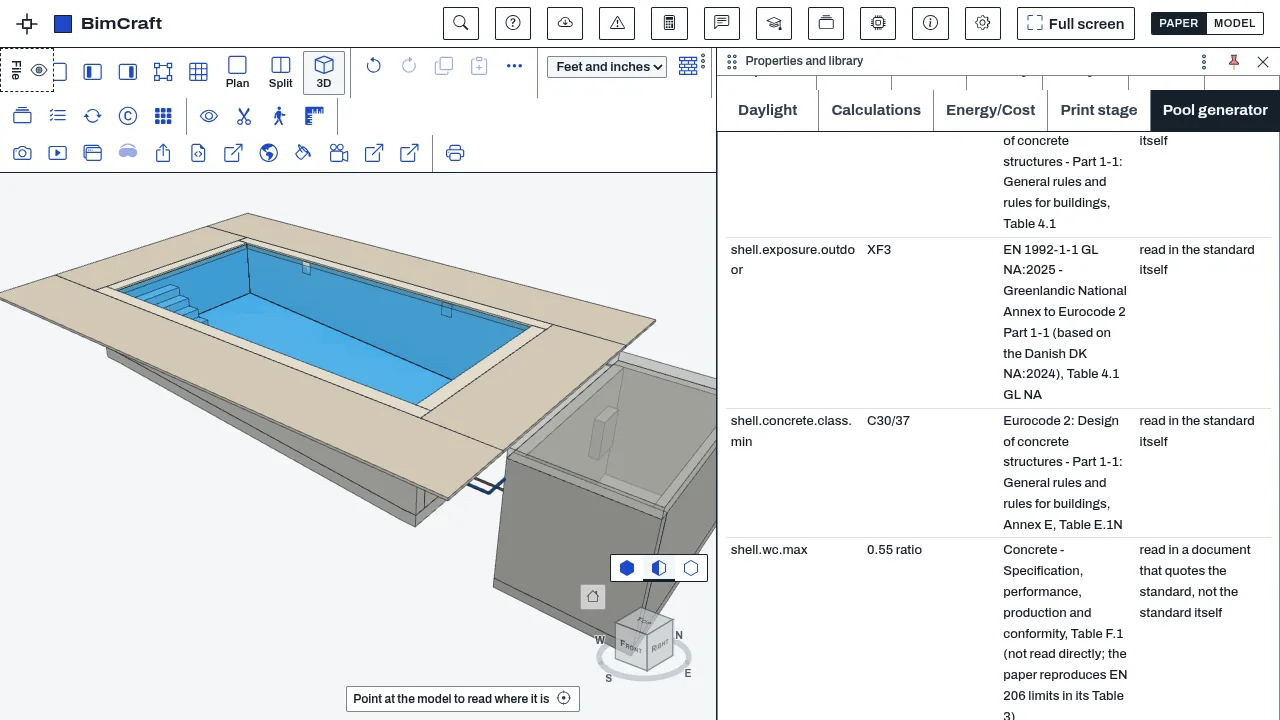
Every value names its standard and clause, and says whether we read it in the standard's own text, in a document that quotes the standard, or could not read it at all (then there is no value). The Eurocode values are the recommended ones; each country's National Annex may change them. EN 1992-1-1:2004 and EN 1992-3:2006 were read; the 2023 second-generation Eurocode 2 that replaces them was not. The skimmer value is from a French decree for public pools whose text is marked abrogated. The barrier height is French and was read in guides, not in the standard. It is not a substitute for the standards, and a licensed engineer must design and check the pool.
Who it’s for
To be written (AL.3): the people and the jobs this serves (docs/0.8-SOUND-SPEC.md § 2 shows the depth expected).
What you can do
- Fill the Pool generator's empty boxes from the spec's values where it has one the generator can use.
- See each rule with its standard, clause and how it was read, in the Pool generator's Spec section.
- Get a row in the result, and in Problems, for every figure that breaks a value in the spec.
- Read the rules the generator does not use as numbers (exposure classes, crack width rule, leak test, slip classes, drain rules) beside the ones it does.
Methods and standards
A rule is used by the generator only when its value is a number in the unit the generator works in. A minimum raises a starting figure; a maximum lowers it; your own figure always stands and is reported when it breaks the rule. A rule that the source wrote for private or for public pools is applied to that use only. Rules that are labels, ranges or sentences are shown, not applied. Standards: EN 1992-1-1 and EN 1992-3 (the concrete shell: exposure class, concrete class, cover, crack width, wall thickness, bar spacing), EN 206 (water to cement ratio), EN 16582 and EN 16713 (domestic pools: leak test, turnover, filter rate, suction outlets), EN 15288 (public pools), and national rules where there is no European one: the German accident insurers' slip classes, DIN 19643 for public pool flow, and French rules for barriers and skimmers.
Data and sources
The pack is made from research done on 2026-11-19, kept in the source as tools/pool/research/eu.json: for every rule the value, the standard, the clause, the page it was read on and the sentence read. No value was typed from memory. Values are in SI units; the pack says so where a value was converted. The Eurocode values are the recommended ones; each country's National Annex may change them. EN 1992-1-1:2004 and EN 1992-3:2006 were read; the 2023 second-generation Eurocode 2 that replaces them was not. The skimmer value is from a French decree for public pools whose text is marked abrogated. The barrier height is French and was read in guides, not in the standard.
Verification
To be written (AL.3): benchmark cases and their results, linked to the verification manual (IND.1).
Limits
To be written (AL.3): what it does not do, and where its answers stop being good. Every engineering item says “a design aid, not an engineering approval”.
Files and formats
To be written (AL.3): what it reads and writes, and what it stores inside drawings.
Get started
To be written (AL.3): three steps and a sample file to open.
Languages
The text is available in:
- English (en)
Works in
| Edition | Works | Note |
|---|---|---|
| Browser (/use) (yours) | Added on demand | Fetched the first time you use it, then kept for offline use. |
| Studio from getcadcraft.com | Added on demand | Fetched the first time you use it, then kept for offline use. |
| Microsoft Store | Added on demand | Fetched the first time you use it, then kept for offline use. |
| Google Play | Added on demand | Fetched the first time you use it, then kept for offline use. |
| iPad and iPhone (App Store) | Included; switch it on | Part of the reviewed app; your list switches it on. |
| Custom build | Added on demand | Fetched the first time you use it, then kept for offline use. |
Comes with
- Pool generator 1.4 MB
Adding it brings these too. Engines are shared: each downloads once for every add-on that uses it.
Versions
| Version | Channel | Date | What changed |
|---|---|---|---|
| 0.11.0 | stable | November 21, 2026 | Signed and published. |
Licence and maker
CadCraft (CadCraft, first-party). Licence: Apache-2.0. Dependencies carry their own licences, listed on their pages.