Feature
Pool generator
A swimming pool or fountain from length, width and depth: concrete shell, steps, tiles, coping and paving, filter, pump, pipes and a machine room, with quantities and an IFC file.
Use this add-on:
Overview
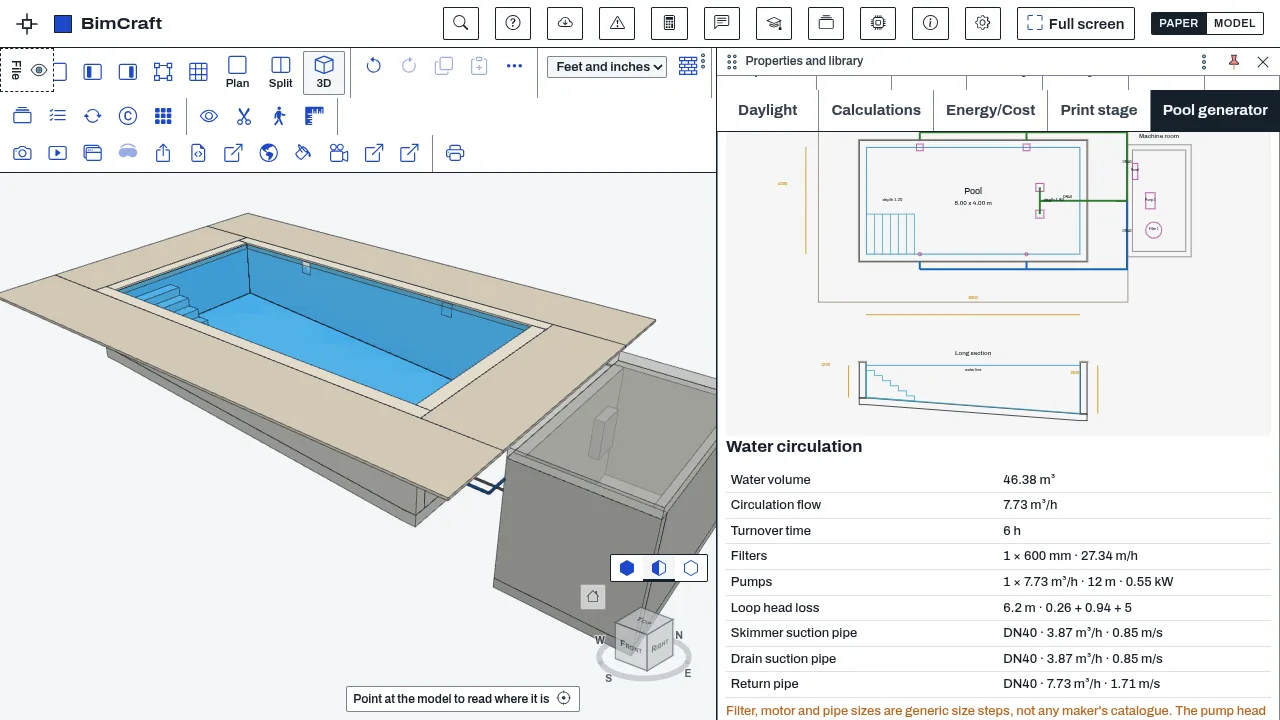
The Pool generator makes a swimming pool or a fountain from three numbers: length, width and depth. From them it builds the reinforced concrete shell with its sloping floor and entry steps, the tile finish, the coping and paving, skimmers or an overflow channel all round, the main drains and inlets, the filter and pump in a machine room, and the pipes that join them. It works out the water volume, the circulation flow, the filter, pump and pipe sizes, and the quantities to price the job.
In BimCraft the pool is placed in your model as real elements. In CadCraft its plan and long section are drawn as ordinary entities. Either way you can save it as an IFC file. Norm values are not built in: they come from spec side add-ons, one per set of norms (Europe, United States), and every value says which standard and clause it is from and whether we read it in the standard itself. It is a drawing and take-off aid: a licensed engineer must design and check the pool.
Who it’s for
- A pool builder or landscape designer who needs a first layout, a model and quantities for a quote.
- An architect placing a pool or a fountain in a building or a garden model and handing an IFC file to the team.
- An engineer who wants the geometry and the take-off done before starting the real structural and hydraulic design.
- A student learning how a pool, its circulation and its machine room fit together.
What you can do
- Make a pool from length, width and the water depth at each end, with a floor that falls in one slope, and get its water volume. Pool generator tab, Shape. verified
- Add entry steps in a corner or across the shallow end; the risers are made equal down to the sloping floor. Shape, Entry steps. verified
- Choose skimmers or an overflow channel all round with its grating and a balance tank. Shape, Overflow. verified
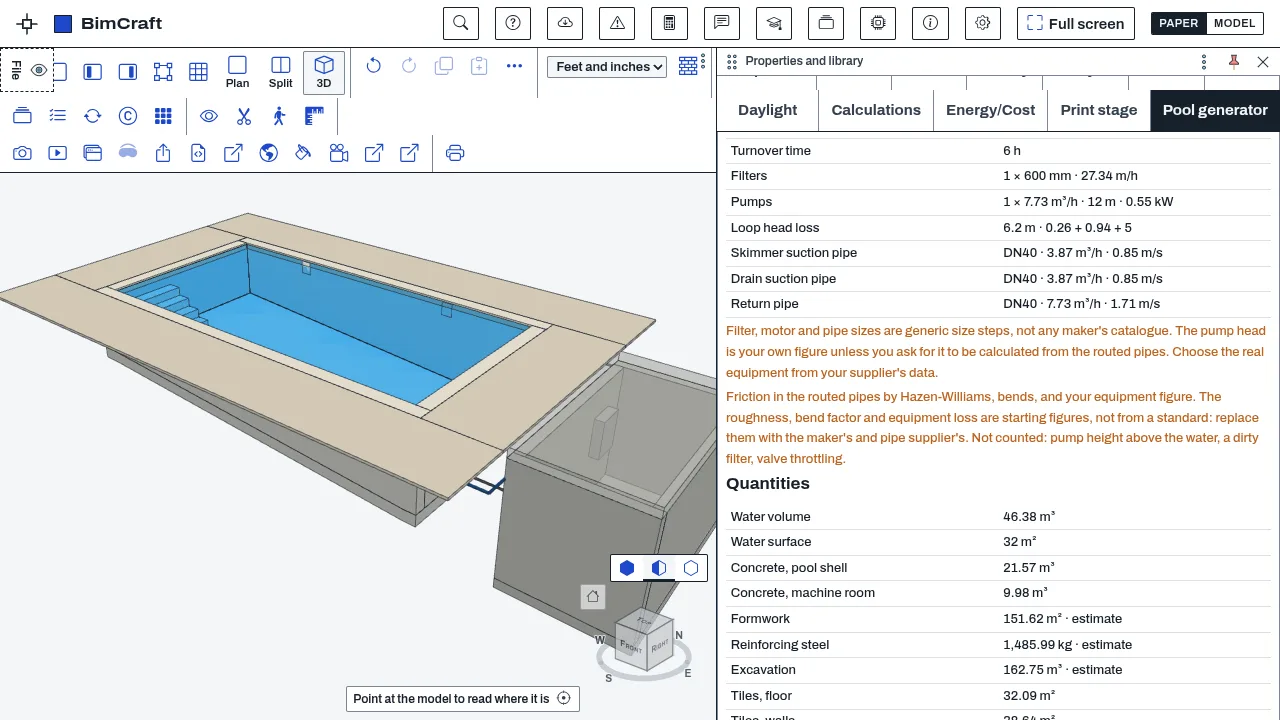
- Get the circulation: flow from the turnover time, filter area and size, pump power from your head figure or from the head loss in the routed pipes, pipe sizes from a velocity limit, and the number of skimmers and inlets. Result, Water circulation. verified
- Get a machine room sized round the filters, pumps and panel, on any side of the pool, with suction and return pipes routed round the pool to it. Machine room. verified
- Get quantities: concrete, formwork, an estimate of the steel, excavation, tiles and pavers to order, coping, pipes by size. Result, Quantities, and Save quantities (CSV). verified
- Pick a spec from a side add-on and see which figures it set, which are your own, which are only starting figures, and what breaks the spec. Spec. verified
- Place the pool in a BimCraft model as elements with properties and quantities, in one undo step. Place in the model. verified
- Draw the plan and the long section in CadCraft on POOL- layers. Draw plan and section. verified
- Save the pool as an IFC4 file from either app. Save as an IFC file. verified
- Make a fountain basin with jets, a sump and a pump. Shape, What to make. verified
Methods and standards
The shell is plain geometry: a floor slab that follows the slope, four walls on it, steps cut to equal risers, each an extruded solid whose volume is its profile area times its length. The water volume is the prism under the water line less the steps. The circulation flow is the water volume divided by the turnover time. The filter area is the flow divided by the filter rate, and the smallest filter step that gives it is chosen (two to four filters when one is too small). Pump power is density times gravity times flow times the head, divided by the efficiency; the head is your figure, or the loss in the routed pipes (Hazen-Williams friction and bends) plus your equipment figure when you choose that. A pipe is the smallest size step whose bore keeps the flow under the velocity limit. Pipes are routed square-cornered round the pool by the shortest way that does not pass under it, except the drain line, which runs under the slab.
No norm value is in the generator. A spec side add-on carries them as data, and each value records its standard, clause, the page it was read on and whether that was the standard's own text. The generator reads only values it can use as a number in the right unit, and applies a value written for private or public pools only to that use.
Data and sources
The generator ships no norm data. Its starting figures (wall and floor thickness, cover, steel ratio, turnover time, filter rate, velocities, skimmer spacing) are round numbers that are not from any standard, and the panel and every report say so beside each one. Filter diameters, motor ratings and pipe sizes are generic size steps marked unverified: they are not any maker's catalogue, and no maker's equipment data is included. Norm values come from the spec side add-ons, which list their sources value by value.
Verification
| Case | Result |
|---|---|
| Water volume and concrete against hand calculation | A flat 8 by 4 m pool 1.2 m deep with no steps holds 38.4 cubic metres, and its slab and walls match the closed-form volumes; a sloped pool holds length times width times the mean depth (bin/test-pool.mjs) |
| Steps: equal risers down to the floor | A flat 1.2 m deep pool with a 200 mm riser limit gets six risers of 200 mm and five treads, 1.35 cubic metres of steps taken off the water; on a sloping floor the riser count rises until the bottom riser equals the others (bin/test-pool.mjs) |
| Skimmer and overflow-channel pools | An overflow pool has no freeboard, a channel, a grating, a balance tank and no skimmers; a skimmer pool has a coping and one skimmer per stated surface area (bin/test-pool.mjs) |
| Flow, filter, pump and pipes against hand calculation | 36 cubic metres an hour at 1 m/s needs a 112.8 mm bore and takes the 125 step; 36 cubic metres an hour against 10 m is 0.98 kW of water power; the filter is the smallest step whose area carries the flow at the rate, and four of the largest are flagged when even they are too small (bin/test-pool.mjs) |
| Head loss in the routed pipes against hand calculation | 50 cubic metres an hour in 10 m of 100 mm pipe at C 140 loses 10.67 L Q^1.852 / (C^1.852 D^4.871) of head, a bend costs K v squared over 2g, and a calculated head equals suction path plus return path plus the equipment figure and drives the pump power (bin/test-pool.mjs) |
| Pipes go round the pool to the room on every side | With the machine room on each of the four sides, with skimmers and with an overflow channel, no suction or return collector passes through the pool in plan, and every pipe has a length and a size (bin/test-pool.mjs) |
| Quantities add up | Tile areas match the closed forms for the floor, walls and steps, tiles to order follow the tile, joint and waste, pipe lengths by size equal the routes, and the CSV quotes cells a spreadsheet would run as formulas (bin/test-pool.mjs) |
| Where each figure comes from | A person's figure always stands and is reported when it breaks the spec; an empty box takes the spec's minimum when that is larger than the starting figure; a rule written for public pools is not applied to a private one; a value with no page it was read on is refused (bin/test-pool.mjs) |
| Placed in a real BimCraft page | In BimCraft's lab build the add-on is switched on, a pool is placed in a model as elements with the CadCraft_Pool property set, placing again replaces them, and Undo takes them out (tools/pool/browser.mjs) |
| Drawn in a real CadCraft page | In CadCraft's lab build the plan and section are drawn on POOL- layers in one undo step and removed again (tools/pool/browser.mjs) |
| The IFC file read back | The file is read by our own IFC reader: every line has the number of attributes its class has in IFC4, every GlobalId is 22 characters and unique, the walls, slabs, coverings, filter, pump and pipes are there, and the same pool writes the same file twice (bin/test-pool.mjs) |
| A fountain | A fountain has one depth, no steps, skimmers or inlets, a sump, its jets, and a flow that is the larger of the turnover flow and the jets' flow (bin/test-pool.mjs) |
Limits
It is a design aid, not an engineering approval, and it does not design the pool: nothing is checked for strength, ground water, uplift, cracking, entrapment or electrical safety, and we accept no liability for what is built from it. A licensed engineer must design and check the pool. The steel is an estimate from a ratio, not a bar schedule. The pump head is your figure unless you ask for it to be calculated from the routed pipes; that adds friction (Hazen-Williams), bends and your filter-and-valves figure, with roughness, bend factor and equipment loss as starting figures that are not from a standard, and it leaves out pump height, a dirty filter and valve throttling. The balance tank is a share of the pool volume that you set, not a calculation. Rectangular pools only, one straight floor slope, steps at the shallow end only. Pipes stop at the machine room wall and are not connected to the equipment; there are no ports in the IFC file. Indoor pools get no ventilation or dehumidifying. Inputs are in millimetres. English only so far. It has been tested against hand calculations and read back with our own IFC reader, not built, not checked by an engineer, and the IFC file has not been opened in another vendor's program.
Files and formats
Writes an IFC4 file of the pool (elements in their own classes with colours, a CadCraft_Pool property set, base quantities and materials), and a CSV file of the figures and quantities with where each figure came from. In BimCraft it writes elements into the open model, saved with it. In CadCraft it writes polylines, lines, text and dimensions on POOL- layers, which export to DXF and DWG. It reads nothing but what you type and the spec packs of the side add-ons you switched on.
Get started
- Switch the add-on on in Settings, Add-ons, then open the Pool generator tab.
- Type the length, the width and the two depths. Look at the plan, the section and the quantities under Result.
- Add a spec side add-on (Pool spec: Europe or Pool spec: United States), pick it under Spec, and read what it set and what breaks it.
- Place the pool in the model (BimCraft) or draw the plan and section (CadCraft), or save the IFC file.
Languages
The text is available in:
- English (en)
Works in
| Edition | Works | Note |
|---|---|---|
| Browser (/use) (yours) | Added on demand | Fetched the first time you use it, then kept for offline use. |
| Studio from getcadcraft.com | Added on demand | Fetched the first time you use it, then kept for offline use. |
| Microsoft Store | Added on demand | Fetched the first time you use it, then kept for offline use. |
| Google Play | Added on demand | Fetched the first time you use it, then kept for offline use. |
| iPad and iPhone (App Store) | Included; switch it on | Part of the reviewed app; your list switches it on. |
| Custom build | Added on demand | Fetched the first time you use it, then kept for offline use. |
Comes with
Nothing else.
Needed by: Pool spec: Europe, Pool spec: United States.
Permissions
- Adds a panel section
- Opens or saves its own file types
- Keeps its own settings in this browser
- Uses "problems"
From its manifest. Shown again when an update changes them, and the update waits for your yes.
Versions
| Version | Channel | Date | What changed |
|---|---|---|---|
| 0.11.0 | stable | November 21, 2026 | Signed and published. |
Licence and maker
CadCraft (CadCraft, first-party). Licence: Apache-2.0. Dependencies carry their own licences, listed on their pages.