Generators
QuantScope generators: exchanger, manifold, lattice beam
Use this add-on:
Overview
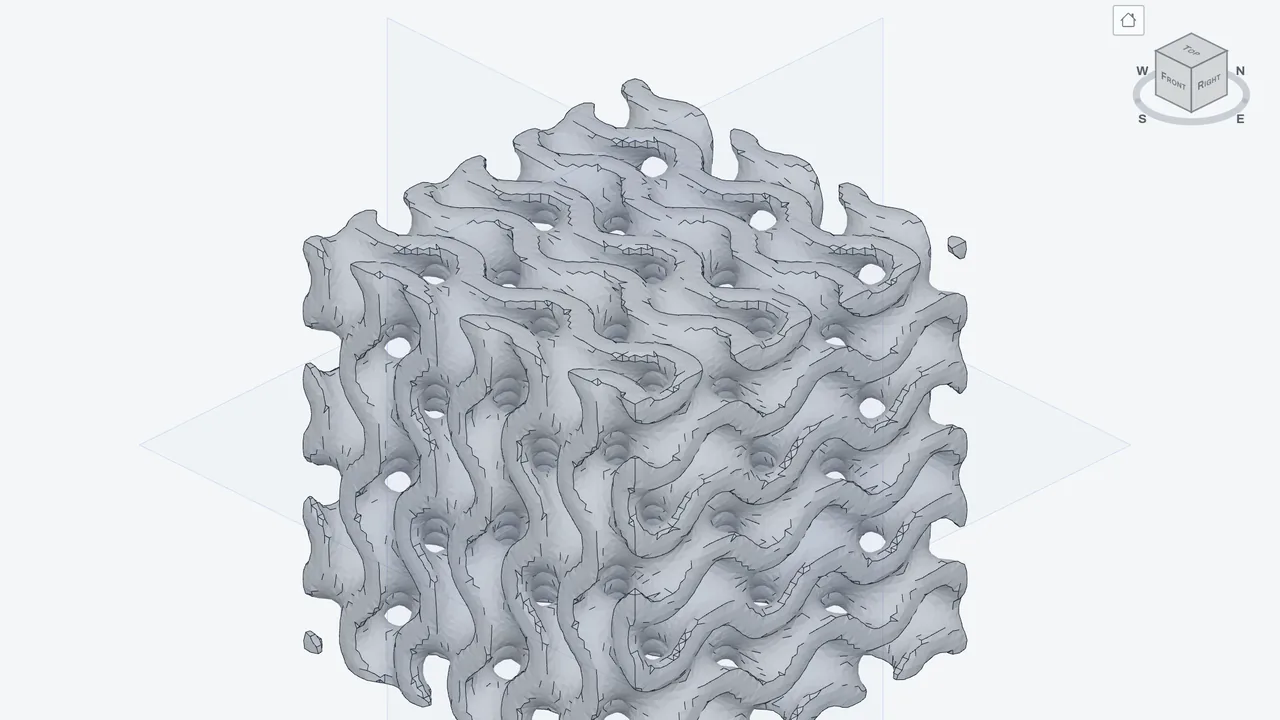
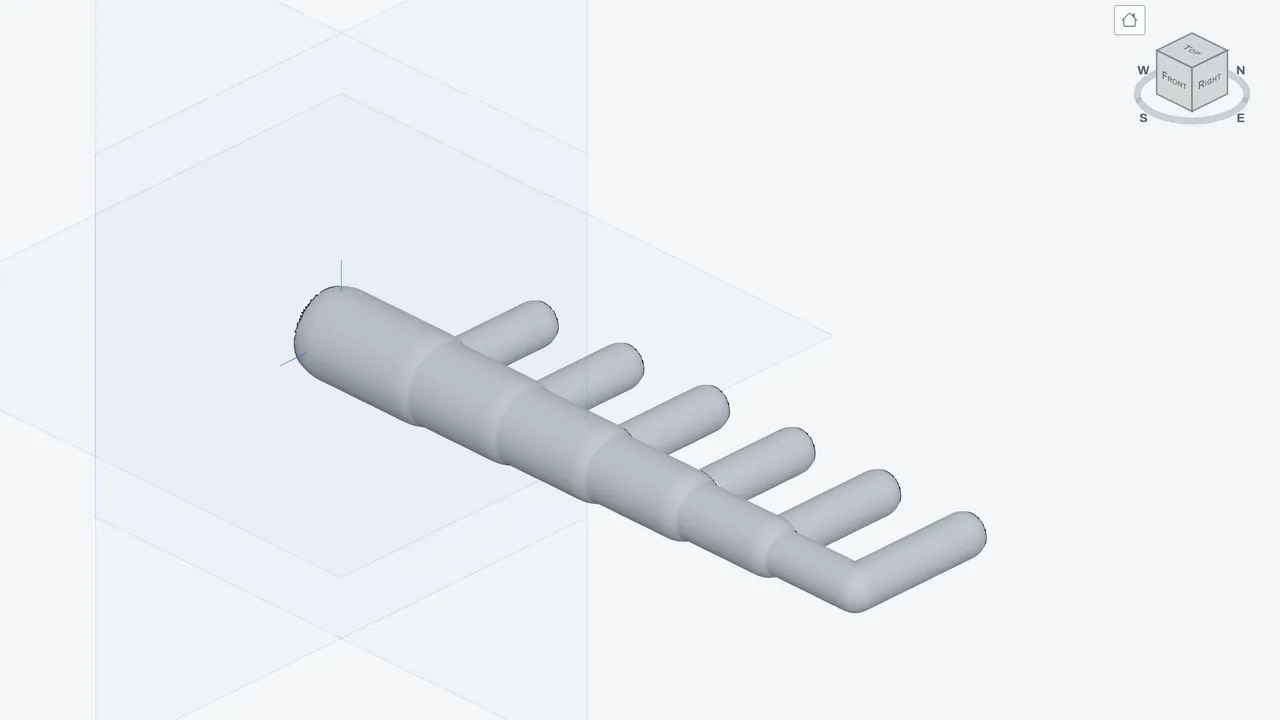
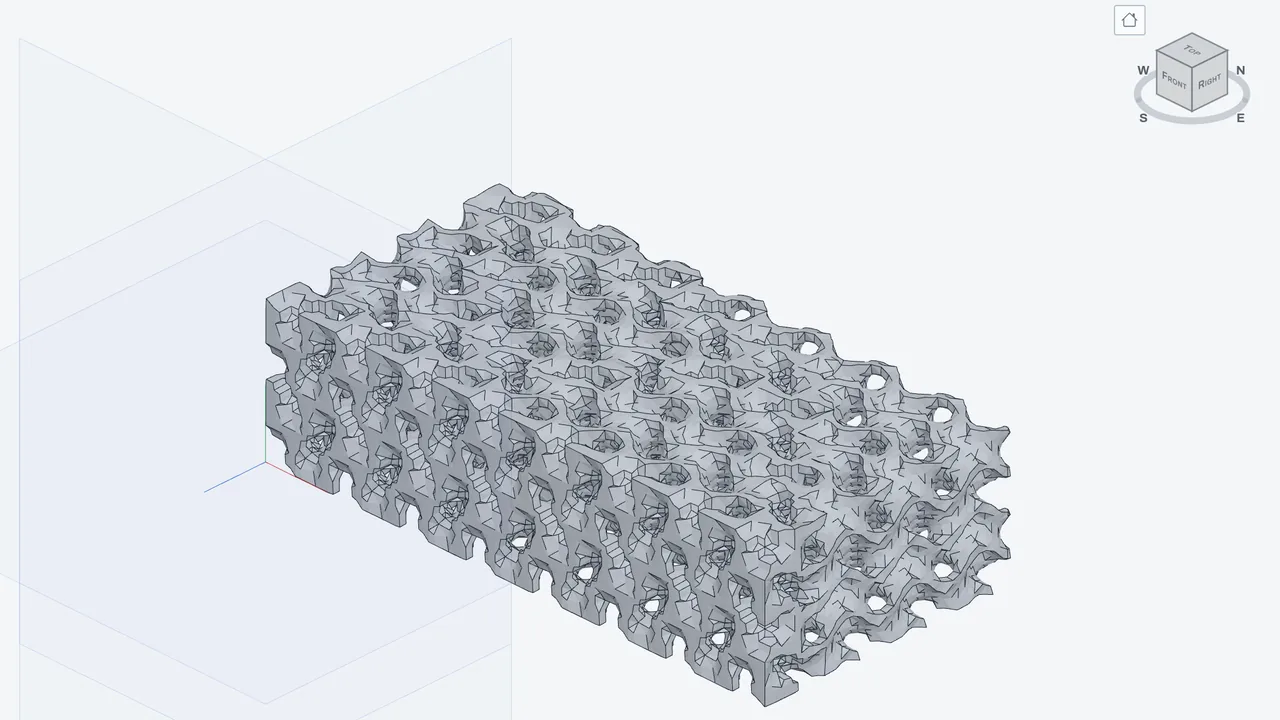
Four generators that ship with QuantScope in PartCraft. Each is a script with typed inputs that sizes a part from textbook formulas and builds it: a gyroid heat exchanger core, a distribution manifold, a graded lattice beam and a gyroid block. Each one makes a body in the part with its data sheet and its checks. They are first estimates for an engineer to check.
Who it’s for
- Heat exchanger and thermal designers who want a first core size from the duty and the two flows.
- Piping and hydraulic designers who want a header and its branches sized for a flow.
- Designers of lattice parts who want a starting graded lattice from a topology optimisation.
What you can do
- Gyroid heat exchanger: duty, hot and cold inlet temperatures and flows, working pressure, wall material and safety factor, cell size, path stretch and pressure drop limit. It sizes the cube and its wall and reports both pressure drops. It can check the pressure drop with a flow study on one cell.
- Distribution manifold: total flow, number of outlets, outlet pitch, branch length, speed limit, water temperature, working pressure and material. It sizes each header stretch and branch tube, and its wall.
- Graded lattice beam (half MBB): length, height, thickness, material fraction, cell size, and the thinnest and thickest wall. The wall follows a 2-D topology optimisation.
- Gyroid block: a block filled with a gyroid, Schwarz P or diamond sheet.
- Check any of them against a printing process (FDM, SLA, SLS or metal). The findings go to Problems.
Methods and standards
Heat exchanger: effectiveness-NTU with counterflow sizing, the hydraulic diameter of a gyroid channel, round-tube heat transfer as a first estimate, and the wall as a thin cylinder at the allowable stress (yield over the safety factor). Manifold: continuity, the thin-wall cylinder and Darcy-Weisbach friction per stretch. Lattice beam: the 88-line SIMP topology code of Andreassen and co-authors on a 2-D density image, turned into a wall thickness over a gyroid lattice. Each value's source is in its data sheet.
Data and sources
Each generator is a .craft script in lib/engineer/generators with an index. Material allowables, fluid properties and process profiles come from the engineering library and are cited in the data sheet. The process figures are round values from public design guides, not a machine's specification. You can add your own generators by opening a file.
Verification
tools/field-test/generators.mjs: 46 passed, 0 failed (coarse sizes, including the pressure drop limit and the flow-study check). browser-generated.mjs: 19 passed, 0 failed. Recorded in docs/0.8-sessions/engineer.md. The heat exchanger sizing is not yet checked against a built reference unit.
Limits
The heat exchanger is the core only, with no headers, ports or fittings. The manifold has no tee losses and no flow sharing between outlets. The lattice beam is a 2-D design for a 3-D lattice, and its wall range is a choice rather than a computed stiffness; run Simulation on the result before relying on it. A wall thicker than about 0.3 of a cell closes the channels, and the generator refuses it. The nozzle example is kept out of released builds until the export-control check is done. These are first estimates, not a design.
Files and formats
Generator scripts are .craft text files with an @generator and @input header. A generator's text is copied into the part, so a file does not depend on this folder. The output is a body in the PartCraft part file, and its data sheet as JSON or PDF.
Get started
- In PartCraft, switch to the Engineer workspace.
- Pick Gyroid heat exchanger, Distribution manifold or Graded lattice beam, and press New.
- Set the inputs, read the data sheet and the checks, then save the part.
Languages
No languages are listed for this add-on yet. Its maker may add some.
Works in
| Edition | Works | Note |
|---|---|---|
| Browser (/use) (yours) | Added on demand | Fetched the first time you use it, then kept for offline use. |
| Studio from getcadcraft.com | Added on demand | Fetched the first time you use it, then kept for offline use. |
| Microsoft Store | Added on demand | Fetched the first time you use it, then kept for offline use. |
| Google Play | Added on demand | Fetched the first time you use it, then kept for offline use. |
| iPad and iPhone (App Store) | Added on demand | Fetched the first time you use it, then kept for offline use. |
| Custom build | Added on demand | Fetched the first time you use it, then kept for offline use. |
Comes with
- QuantScope Size when built
- Field kernel 1.2 MB
- QuantScope library 900 KB
Adding it brings these too. Engines are shared: each downloads once for every add-on that uses it.
Needed by: Additive manufacturing engineering, Aerospace (aircraft), Autonomous systems and drones, Battery and electrochemical engineering, Biomechanical engineering (implants, prosthetics), Building envelope and façade engineering, Mechanical design (parts and assemblies), Naval architecture and marine engineering, Tooling, mold and die design.
Versions
| Version | Channel | Date | What changed |
|---|---|---|---|
| 1.0.0 | stable | October 28, 2026 | First version in the Library. |
Licence and maker
CadCraft (CadCraft, first-party). Licence: Apache-2.0. Dependencies carry their own licences, listed on their pages.